
The Queen of Pop and the LGBTQ+ Community
Susan Sarandon said it best: “The history of women in popular music can, pretty much, be divided into before and after Madonna.”
I can’t remember a time when Madonna didn’t have some kind of influence on my life. It is Madonna who made me the performer I am today. I remember specifically the summer of 1990; I was about to enter first grade, and my mom had friends over to watch the Blond Ambition Tour live on HBO. I am so thankful she thought to record that concert on our VCR. I would watch that video over and over again, recreating the dance moves to the horror of my family.
My mom would make me fast-forward through the “Like a Virgin” performance. I didn’t understand the concepts of her lyrics just yet, but I loved her songs, her energy, and her stage presence. I remember wondering what it felt like to have that many people screaming your name and singing your songs. I wanted to be Madonna! I listened to The Immaculate Collection on a loop. During recess, I would spend the entire time singing her songs at the top of my lungs while swinging on the swing set until I actually got sick. My first performance in front of anyone besides my family was for my first-grade class—and my song of choice was "Vogue." Needless to say, Madonna literally taught me how to express myself.
A few years later, after I was "banned" from listening to Madonna during the Erotica era, I was reintroduced to her in Evita. It started my love affair with musical theatre; in fact, Evita was the first musical soundtrack I ever owned. As I suffered through middle school, I found my tribe and safety in the drama club. In my freshman year of high school, we had a fundraiser called “The Freak Fashion Show.” It was a Halloween-inspired talent show to raise money for our spring productions. When the time came for auditions, I decided to try doing “drag” for the first time. I put on whatever women’s clothes I could find in the drama room that would fit. I had smuggled one of my mom’s bras to school that day, bought a pair of black nylon tights from Walgreens, and wore a horrible Walmart Halloween wig. After my performance of “Ray of Light,” my drama teacher told me how much he enjoyed the “passion” I put into the performance, but he wasn’t sure if our small town was “ready” for what I was trying to present. Just five years later, I would perform “Vogue” in drag at a Thursday night talent night at a gay bar in Cocoa, Florida, called The Drama Club. The rest is history.
Madonna's influence on me is undeniable, but her impact on the LGBTQ+ community and specifically drag culture runs deep. Her outspoken advocacy grew during the height of the AIDS epidemic. Her involvement was more than celebrity philanthropy; it was deeply personal and radically defiant. In an era when the U.S. government largely ignored the epidemic, Madonna used her peak fame to force the world to look at it. Her activism wasn't born from a PR strategy; it was a response to the loss of her closest friends and mentors, including Keith Haring and her dance teacher Christopher Flynn. She would even travel to Mexico to get medicines not available in the U.S. to try to help her friends.
In 1989, she did something unprecedented: inside every copy of her album “Like a Prayer”, she included a card titled "The Facts About AIDS." It stated plainly that people with AIDS deserve "compassion and support, not violence and bigotry.” Putting safe-sex instructions and a plea for empathy into millions of homes was a massive professional risk that few other stars were willing to take. Her advocacy continued through countless benefit concerts, her “Raising Malawi” Foundation. Those efforts were put on full display on tour as she sang “Live To Tell” during her Confessions Tour and then again on the “Celebration Tour” with the faces of people who died from AIDS projected on screens throughout the arena.
What Madonna Teaches the Performer
Then there is the multifaceted relationship between Madonna and drag. Perhaps her most direct connection is detailed through the "Vogue" single and video, which introduced the ballroom scene, voguing, and house culture (all deeply rooted in the LGBTQ+, specifically Black and Latinx, community) to a global audience. While sometimes criticized as appropriation, it undeniably gave this underground culture immense visibility and validated it as high art.
Her own career has consistently employed elements synonymous with drag: exaggerated glamour, gender play, theatricality, dramatic makeup, and meticulously crafted personas. She essentially brought drag sensibilities to the pop music stage. Countless drag performers have impersonated her, drawn to her iconic looks, powerful stage presence, and unwavering confidence. Her imagery provides a rich archive for drag artistry. Furthermore, her concerts, music, and overall brand created safe, celebratory spaces for LGBTQ+ people, including drag performers, long before mainstream acceptance. And let’s not forget the 1999 MTV VMA’s when a parade of queens dressed as Madonna from her different eras joined her on stage. Or, the countless references to her on RuPaul’s Drag Race. In fact, RuPaul’s Drag Race star Bob the Drag Queen served as emcee for Madonna’s most recent tour.
Songs like "Express Yourself" and "Vogue" became anthems for self-acceptance. She essentially brought drag sensibilities to the global stage. For those of us in the art of drag, she offers four vital lessons:
1. The Art of Strategic Reinvention
- The Lesson: Don't be afraid to kill off an old version of your persona to make room for the new. Whether it’s moving from "club kid" to "theatre queen" or "hostess" to "advocate," evolution is the only way to survive the ever-changing entertainment landscape of drag.
2. The Power of Discipline
People often credit Madonna’s success to her provocations, but her real secret is her infamous work ethic. Her tours are legendary for their complexity, and that only happens through grueling rehearsal and discipline. From her physical fitness to her attention to detail in costuming and staging, she expects the best from herself, and from those around her.
- The Lesson: In the drag world, talent gets you in the door, but discipline keeps you there. It’s about the "unseen" work: the hours spent editing a mix, the meticulous curation of a look, rehearsed choreography, and the physical stamina required to command a stage for two hours. Excellence is a habit. What you do offstage is a direct reflection of what you do onstage.
3. Crafting the 360-Degree Brand
Long before "personal branding" was a buzzword, Madonna was the mastermind. She understood that the music was just one piece of the puzzle. Every music video, every look, and every interview served a single, cohesive narrative.
- The Lesson: As drag performers, we are our own CEOs. Your brand isn't just your performance or your aesthetic; it’s how you present yourself to the public, and the way you treat people backstage. Nothing will ruin your brand faster than being a difficult person to work with.
4. Fearless Expression and Productive Provocation
Madonna taught us that a platform is a terrible thing to waste. She didn't just push boundaries for the sake of a headline; she pushed them to move the needle on social issues, religion, and sexuality. We have her to thank for bringing some of the social issues of our time to our dining room tables, whether it made people uncomfortable or not.
- The Lesson: Drag is inherently political. Use your voice. Whether you are speaking at a festival or hosting a community fundraiser, remember that your visibility is a tool for change. Authenticity might be uncomfortable for some, but it is the only way to build a legacy that matters. Plus, visibility for our community is more important now than ever. Use your platform, and use it for good. You don’t know who is looking to you as inspiration.
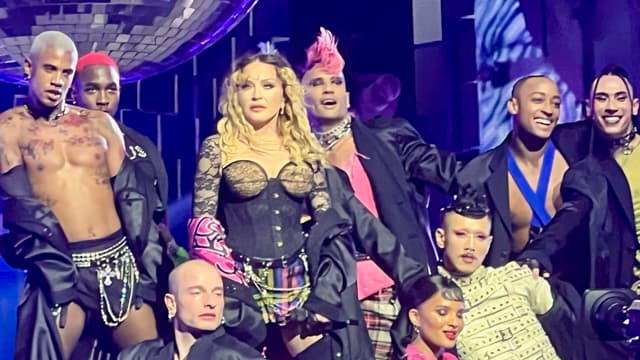
I had a full-circle moment during the Celebration Tour in 2024. I was seeing Madonna four days after my 40th birthday, while she was celebrating 40 years of music. Since I was going to be so close to her in the VIP section, I had to put a look together: the “Dress You Up” look from the Virgin Tour. When she was singing “Bad Girl,” she was right in front of me. She had her eyes closed, but when she opened them, she saw me and almost broke character. The smile and nod of approval she gave me was more than I could ever hope for. I felt like I was knighted by the queen!
Madonna’s legacy isn't just about her past achievements, but about the enduring inspiration she provides. I know that I wouldn’t be who I am personally or professionally without my “Lucky Star,” Queen Mother Madonna Louise Veronica Ciccone.
I can’t wait to see what Madonna has in store for us in 2026! Until then, I want to hear from you: What was the first Madonna song or moment that made you feel seen? Drop your story in the comments below!